Why Your Competitor Shows Up on Google and You Don't
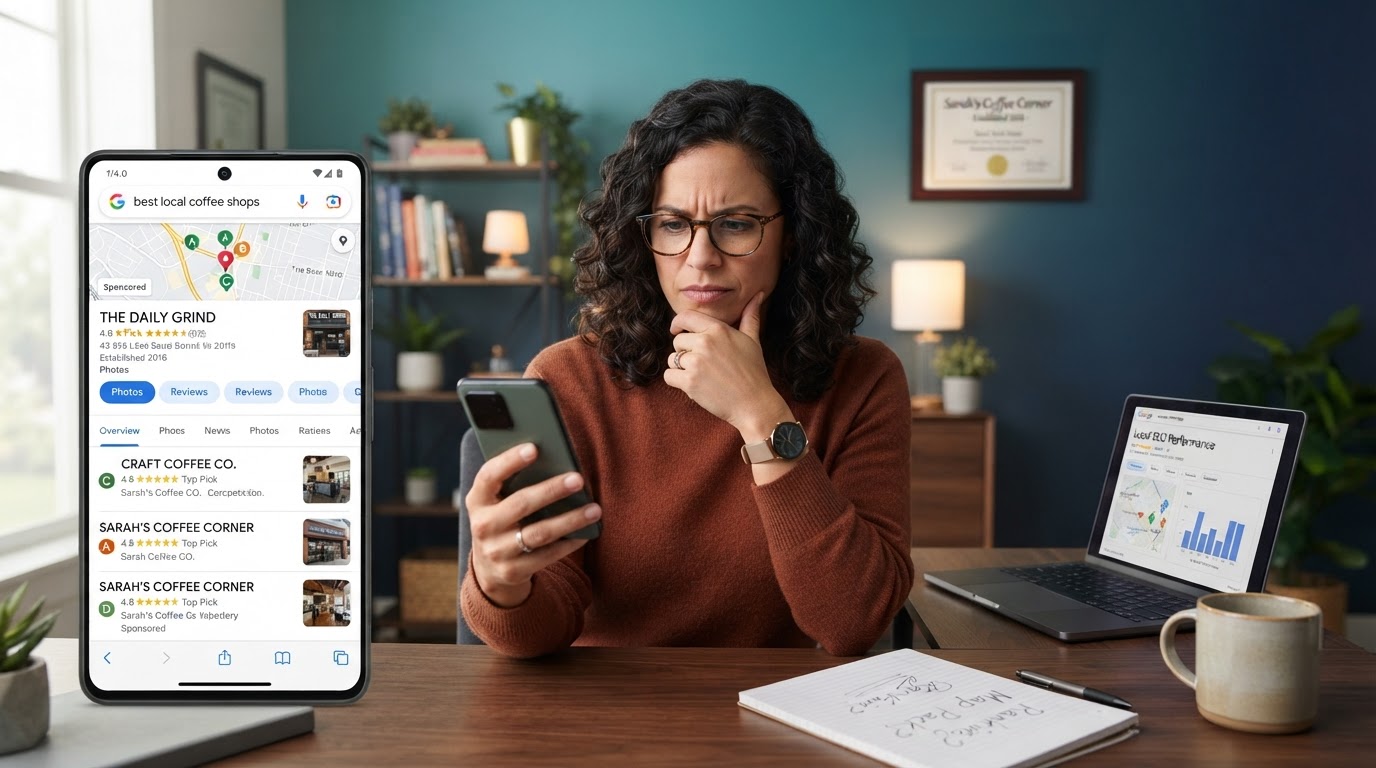

You've seen it. You search for your service in your city, and there they are — your competitor, right at the top of Google, with the map pin, the reviews, the photos. You scroll past them looking for yourself and you're nowhere. Page two. Page three. Sometimes not at all.
It feels personal. Like Google is playing favorites. It's not. Google is following a set of signals, and your competitor is sending more of them than you are. The good news: every single one of those signals is something you can control.
Here are the four real reasons they're showing up and you're not — in order of impact.
What this post answers:
- The 4 real reasons your competitor outranks you on Google
- Which factor matters most (and which one to fix first)
- Why a better-looking website won't fix this on its own
- A realistic 30-day plan to start closing the gap
The Real Reason Your Competitor Is Getting All the Google Calls
When a customer searches "plumber near me" or "best HVAC in town," Google doesn't show the best business. It shows the business that sends the clearest signals of relevance, proximity, and prominence. Your competitor isn't necessarily better than you — they're just better at telling Google they exist.
This is the part that frustrates business owners the most. You can be the best at what you do and still lose the Google game, because Google doesn't measure quality directly. It measures signals that correlate with quality — and those signals are specific, documented, and improvable.
Google doesn't rank the best business. It ranks the business that sends the clearest signals. You control those signals.
Factor 1: They Have a Google Business Profile and You Don't (Or Yours Is Wrong)
Your Google Business Profile — the free listing that shows up in Google Maps, the local map pack, and the sidebar when someone searches your business name — is the single most important local visibility asset you own. More important than your website for many local searches.
If you haven't claimed and fully filled out your profile, you're invisible in the map pack. Period. Google can't show what it doesn't know about, and an unverified, incomplete profile tells Google your business is less established than the competitor down the street who filled out every field, added photos, and posted updates.
A complete profile means: every category filled in correctly (not just your primary one), your real business hours, service areas listed, photos uploaded, a description that includes what you do and where, and regular posts. Most businesses do 30% of this and wonder why they don't show up.
Your Google Business Profile is the single highest-impact local SEO asset you own — and most businesses leave it half-finished.
Factor 2: Their Website Is Built to Rank, Not Just to Look Good
A beautiful website that no one finds is a brochure, not a marketing asset. Your competitor's site might not look as polished as yours — but if it's built with the signals Google reads, it ranks. If yours isn't, it doesn't.
What 'built to rank' actually means: your city and service in the page titles and headings, your services on individual pages (not one page listing everything), local schema markup that tells Google your address and service area, a mobile experience that loads fast, and internal links that guide Google through your content.
Most small business websites are built by designers who optimized for appearance, not for search. They look good and rank for nothing. The competitor with the ugly site that ranks above you built theirs — or hired someone who built theirs — with search visibility as the primary goal, not as an afterthought.
A website built to look good but not to rank is a brochure. Your competitor's site is built to be found.
Factor 3: They Have More Reviews and They're More Recent
Google uses review quantity, recency, and velocity as ranking signals for local search. A business with 60 reviews, including several from the last month, sends a stronger signal than a business with 20 reviews, the most recent of which is two years old.
Reviews also drive clicks. When a customer sees your competitor with a 4.8 rating and 80 reviews next to your 4.2 rating and 12 reviews, they click the competitor. Those clicks reinforce the ranking — Google sees that people choose that business more often and rewards it with higher visibility.
The fix isn't complicated: build a system that asks every happy customer for a Google review, consistently, week after week. The businesses that win the review game aren't the ones with the best service — they're the ones with the most consistent review-generation process.
The businesses that win the review game aren't the ones with the best service — they're the ones who ask consistently.
Factor 4: They're Mentioned on Other Websites (Even Locally)
When your business is mentioned on other websites — local directories, the Chamber of Commerce, industry associations, local news, even a partner's site — Google sees those mentions as trust signals. The more consistent and reputable those mentions, the more confident Google is that your business is real and relevant.
These mentions are called 'citations,' and consistency matters: your name, address, and phone number (NAP) need to be identical everywhere they appear. If you're listed as 'Smith Plumbing' on Google, 'Smith Plumbing LLC' on Yelp, and 'Smith Plbg' on a directory, Google gets confused. Inconsistent NAP is one of the most common reasons a business underperforms in local search despite doing everything else right.
Your competitor is probably listed on more directories, has more consistent information across them, and may have a few local links you don't. This is the factor that takes the longest to build — but it's also the one that compounds the most over time.
Inconsistent business name, address, or phone number across the web is one of the most common — and most fixable — reasons businesses underperform in local search.
The Good News: All of This Is Fixable
Here's what makes this less daunting than it sounds: your competitor's advantage is not a secret. It's a set of specific, repeatable actions — claim your Google Business Profile, optimize your website for local search, generate reviews consistently, and build local citations. Every one of those is something you can start this week.
The businesses that stay invisible on Google aren't the ones with bad products or poor service. They're the ones who never started the visibility work — or who started it years ago and let it go stale. Google rewards consistent, ongoing effort, not one-time setup.
For Michigan businesses, the stakes are real. In Grand Rapids alone, 31 web design agencies compete for local search visibility — and the 3-pack on Google is determined by proximity, review count, and Google Business Profile completeness, not by who has the prettiest website. A contractor in Grand Rapids who optimizes their Google Business Profile and builds reviews can pass a competitor who's been around twice as long but never did the work.
Your competitor's ranking is not a permanent advantage. It's the result of work they did that you haven't done yet. Start doing it, and the gap closes.
What to Prioritize First
If you can only do one thing this week, do this:
- 1.Claim and complete your Google Business Profile. Fill every field, add photos, verify your hours, list your services, and write a description. This alone can move you into the map pack within weeks.
- 2.Start asking every customer for a review. Text them the link while they're still happy. Five new reviews in the next 30 days signals activity to Google and builds trust with future searchers.
- 3.Make sure your website has local SEO signals. Your city and service in your page titles, your address on every page, and a mobile experience that loads in under 3 seconds. If your site was built to look good but not to rank, this is where local search optimization comes in.
- 4.Audit your local citations. Search for your business on Yelp, Apple Maps, Bing, and major directories. Make sure your name, address, and phone number match exactly everywhere they appear.
That's a 30-day sprint that will measurably improve your visibility. You don't need to do everything at once — you need to start, and keep going.
If you want to know exactly where you stand and what to fix first, a free growth audit will tell you which of these four factors is costing you the most — and what it'll take to close the gap.
Your competitor isn't smarter than you. They just started the visibility work before you did. The gap closes the day you start.
Frequently Asked Questions
Why does my competitor show up on Google and I don't?
It comes down to four things: they have a complete, verified Google Business Profile while yours is missing or incomplete; their website is built with local SEO signals Google can read while yours is not; they have more reviews that are more recent; and they have mentions on other local websites that act as trust signals. None of these are permanent advantages — they're all fixable, and most can be improved within 30 to 90 days.
How does Google decide who shows up in the local map pack?
Google's local map pack — the top three results with the map pins — is determined by three primary factors: relevance (how well your business listing matches the search), distance (how close you are to the searcher), and prominence (how well-known and trusted your business is, based on reviews, links, and local citations). You can't always control distance, but you have significant control over relevance and prominence through your Google Business Profile, your website, and your reviews.
Do Google reviews actually affect my search rankings?
Yes. Google has stated that review quantity, review recency, and review velocity are all signals used in local ranking. A business with 50 recent reviews will typically outrank a business with 20 older reviews for the same search, all else being equal. Reviews also influence whether someone who finds you actually clicks through — most consumers read reviews before contacting a local business.
What is a Google Business Profile and why does it matter?
Your Google Business Profile is the free listing that appears in Google Maps, the local map pack, and the sidebar when someone searches your business name. It's the single highest-impact local SEO asset you own — more important for local visibility than your website in many cases. If you haven't claimed and fully filled it out, you're handing visibility to competitors who have.
Can I catch up to a competitor who's been on Google for years?
Yes — faster than most business owners think. A competitor who's been around longer has accumulated reviews and citations over time, but a focused effort on your Google Business Profile, a website built to rank, a consistent review-generation process, and local citations can close that gap in months, not years. The businesses that stay invisible are the ones who never start.
How long does it take to improve my Google visibility?
Google Business Profile optimization can produce visible improvements in 2 to 4 weeks. Website SEO improvements typically show in 8 to 12 weeks as Google re-crawls and re-evaluates your pages. Building reviews and local citations is an ongoing effort that compounds over time. A 30-day visibility sprint focused on your Google Business Profile alone can move the needle measurably.
Find Out Why You're Invisible on Google
Get a free growth audit and we'll tell you exactly which of these four factors is holding you back — and what it'll take to start showing up above your competitor.
Get Your Free Growth Audit