
Hire a Web Designer vs. Use Wix or Squarespace: What's Right for Your Small Business?
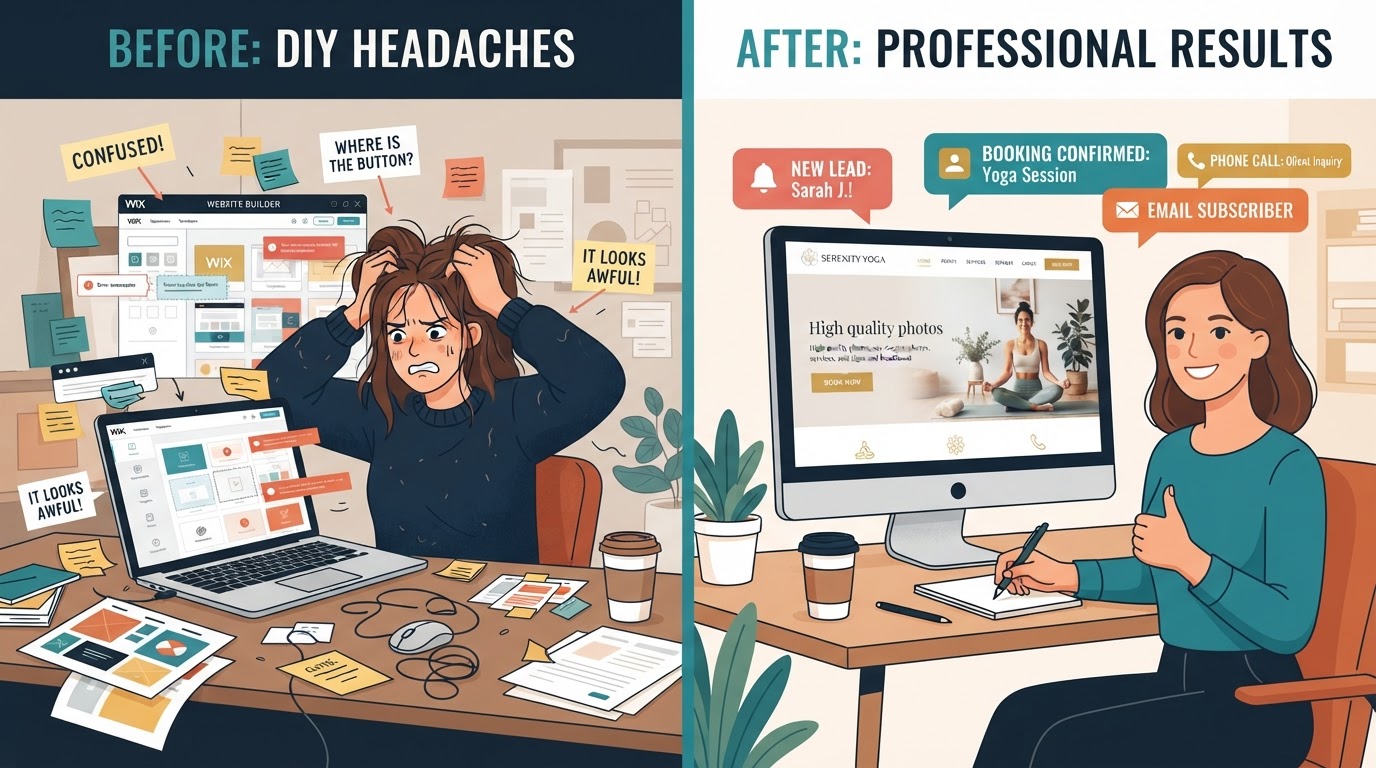

TL;DR — Key Takeaways
- Builders are built for hobbyists, not lead-generation. If your website's job is to get found on Google and turn traffic into calls, a builder isn't engineered for that race.
- The 3-year cost isn't what the ads suggest. A $30/month builder plus your weekends often costs more than a one-time $2,000 custom build — and produces no leads.
- You give up search visibility, conversion strategy, speed control, and ownership. That's the real cost of "cheap."
- Own your domain and content regardless. If a platform or designer won't let you take everything with you, that's a red flag.
You need a website. You've seen the ads for Wix and Squarespace telling you it's easy and cheap to build your own. You've also talked to a web designer who quoted you thousands. Now you're stuck on the question: is a website builder good enough, or do you actually need a professional?
This is the honest answer — not a sales pitch from either side.
Who Website Builders Are Actually Built For (It's Not Small Businesses Who Need Leads)
Wix, Squarespace, and similar platforms are excellent products — for the people they were designed for. They were built for someone who wants to put something online quickly, doesn't want to hire anyone, and doesn't need the site to do anything beyond exist.
That person is typically:
- •A hobbyist or personal brand that gets business from word-of-mouth
- •A freelancer who needs a portfolio page
- •Someone who enjoys tinkering and has the time to do it
Website builders were not built for a service business that needs its website to generate phone calls.
If you run a plumbing company, a dental practice, a law firm, or a landscaping business, your website's job is to get found on Google and turn that traffic into booked appointments. Builders can get you online. They are not engineered to win that specific race.
What You Give Up With a DIY Builder
When you choose a builder over a professional, here's what you're trading away:
Builders add layers of code you can't control, which slows your site down and makes it harder for Google to read. In a competitive local market, that's the difference between showing up and being invisible. Google's own SEO Starter Guide explains why page structure and speed matter for ranking.
A builder gives you a blank canvas. A professional gives you a tested layout that guides a visitor toward calling you. Most owners who build their own site focus on how it looks, not on whether it actually converts.
You can't fully optimize a builder site for Core Web Vitals. You can't strip out the code bloat. You can't control how the platform renders your pages. You're renting space in someone else's building.
Want a booking system that syncs with your calendar? Want lead forms that push into your CRM? Want to track which pages generate calls? Builders offer workarounds. A professional builds it in.
What You Get With a Professional Web Designer
When you hire a professional, you're not paying for a prettier version of the same thing. You're paying for a different outcome. A professional web design for small businesses includes:
- Keyword research before design. Your pages are built around what your customers actually search for — not what looks good in a template.
- A conversion layout. Every page has one clear call-to-action, your phone number is prominent and clickable, and the flow is tested — not guessed.
- Technical SEO baked in. Title tags, meta descriptions, heading structure, schema markup, and fast load times — all configured before launch, not added later.
- You own it. Your domain, your content, your code. If you ever leave, you take it with you.
The difference isn't aesthetics. It's whether the website does the job you hired it to do.
The Real Cost Comparison Over 3 Years
This is the number most comparisons get wrong. They compare the monthly builder fee to the one-time design fee and call it a day. That's not how it works in reality.
| Cost over 3 years | DIY Builder | Professional |
|---|---|---|
| Platform / build | $0 build + ~$30/mo premium plan = $1,080 | $1,500–$3,000 one-time |
| Your time (evenings/weekends) | 40–60+ hours | 5–10 hours (reviews + content) |
| Hosting + maintenance | Included in plan | $50–$150/mo = $1,800–$5,400 |
| Leads generated | Often near zero | Designed to convert |
| 3-year total (cash) | ~$1,080 + your time | $3,300–$8,400 |
The builder looks cheaper — until you factor in your time and the fact that it likely produces no leads. The professional costs more in cash, but the site is built to generate calls. A website that costs $2,500 and brings in 2 extra leads a month at $500 per job returns $1,000/month. The site pays for itself in under 3 months and keeps producing. A builder that costs $30/month and generates zero leads isn't a bargain — it's a sunk cost.
The businesses advertising on Google for web design keywords pay $6 to $27 per click — because a single client is worth thousands. That tells you what the market believes a real website is worth.
When a Website Builder Is the Right Answer
I'm not going to tell you a builder is never the right call — because sometimes it is. A DIY builder is the right choice when:
- You get all your customers from referrals and just need a page to point people to
- You genuinely don't have the budget for a custom build and need something now
- You enjoy building it yourself and have the time to spare
- You don't compete in a search market where ranking matters
If that's you, use the builder, get online, and revisit a professional site when your business grows to the point where leads from search actually matter.
When You Should Hire a Professional
You should hire a professional web designer when:
- Your business depends on getting found by new customers online
- You compete with other local businesses for the same searches
- You want your website to actually generate calls, not just exist
- You need booking, CRM integration, or lead tracking built in
- Your time is better spent running your business than building a website
If your website is supposed to be a lead generator — not a digital business card — it needs to be built like one.
For Michigan businesses, the market makes this decision sharper. Grand Rapids alone has 31 web design agencies competing for local search visibility. The businesses that win the 3-pack on Google Maps are the ones whose sites were built to rank and convert — not the ones running a $30/month template. Whether you're in Lansing, Grand Rapids, or Detroit, the businesses getting the calls invested in a site designed to get found.
One warning regardless of which path you choose: make sure you own your domain and your content. If you ever want to move off a builder or switch designers, you should be able to take everything with you. If a platform or a designer won't let you — that's a red flag.
Frequently Asked Questions
Still Not Sure Which Path Is Right?
Tell us about your business and we'll give you an honest recommendation — even if that recommendation is a DIY builder. Get a free website audit and find out what your business actually needs.
Get Your Free Growth Audit