How to Get More Calls From Google Without Paying for Ads
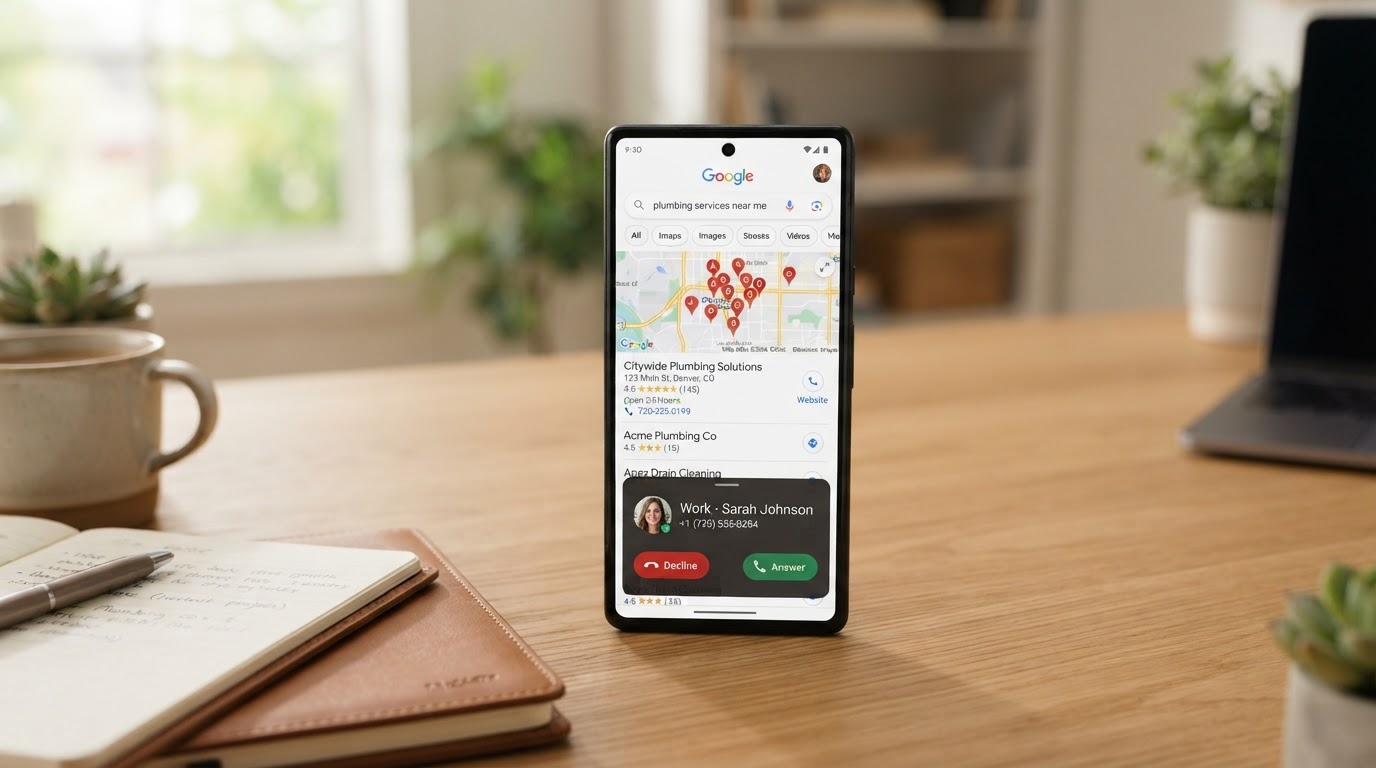

You're paying for Google Ads and the calls are coming in — but the moment you stop paying, they stop. Meanwhile, your competitor across town isn't running a single ad and their phone keeps ringing. How?
It's not luck and it's not a bigger budget. They've built an organic presence on Google that produces calls for free — and it keeps producing month after month whether they spend or not. Here's exactly how that works and how to build it yourself.
Here are the four levers that drive free calls from Google — and a realistic timeline for each.
What this post answers:
- The difference between paid clicks and earned calls — and why earned calls win long-term
- The 4 free levers that drive Google calls for local businesses
- A realistic timeline for each lever — what's fast, what's slow, and what to start now
- How this plays out for Michigan small businesses in competitive local markets
The Difference Between Paid Clicks and Earned Calls
Paid ads are renting visibility. You pay Google a set amount per click, your listing shows up at the top of the page, and as long as the money flows, the clicks come. The moment you pause the campaign — vacation, slow month, budget cut — your listing disappears and the calls stop.
Earned calls are different. They come from your organic presence on Google — your Business Profile ranking in the map pack, your website ranking in the organic results below it, your reviews building trust, your directory citations reinforcing Google's confidence. This presence takes work to build, but once it's there, it keeps producing calls whether you're spending on ads or not.
The smartest local businesses do both. They use paid ads for immediate leads while they're building their organic presence. Then, as the organic calls start coming in, they dial back the ad spend. The businesses that rely on ads forever are the ones who never built the organic side — and they're paying forever for something their competitors get for free.
Paid ads rent visibility — stop paying and it disappears. Earned calls compound over time and keep producing whether you're spending or not. The smart move is building the organic side while you're running ads, then dialing back as the free calls start coming in.
The 4 Levers That Drive Google Calls for Local Businesses
There are exactly four things that determine whether your business gets calls from Google for free. Most businesses do one or two and ignore the rest. The ones that do all four dominate their local search results. Here's each lever, what it does, and how fast it moves.
Lever 1: Your Google Business Profile
The one that moves fastest
Your Google Business Profile is the single highest-impact lever for getting calls. When someone searches '[service] near me' or '[service] [city],' the first thing they see is the map pack — three business listings at the top of the page. The businesses in that pack get the majority of the calls.
Most business owners set up their profile once, years ago, and never touched it again. A complete profile has the right primary category, 10+ real photos, accurate hours, a real description with your services, and recent reviews. An incomplete or stale profile loses the pack to a competitor who did the work.
The Google Business Profile is the fastest lever. A complete, active profile can move you into the map pack within 2–4 weeks — and the map pack gets the majority of calls for local searches.
Lever 2: Your Website's Mobile Experience
The one most businesses neglect
Over 60% of local searches happen on a phone. When someone clicks through from the map pack to your website, they're on mobile — and if your site is slow, hard to read, or buries the phone number, they leave. Google measures this. Your mobile experience directly affects where you rank.
Research from Google's own PageSpeed Insights data consistently shows that a majority of mobile pages fail Core Web Vitals — the speed and stability metrics Google uses as ranking signals. A site that loads in under 3 seconds, has a clickable phone number visible without scrolling, and doesn't shift around as it loads will outperform a prettier site that's slow on mobile every single time.
Over 60% of local searches are on mobile, and most mobile sites fail Google's own speed standards. A fast mobile site with a visible, clickable phone number wins calls that a prettier but slower site loses.
Lever 3: Your Local Search Presence
Directories, citations, and consistency
Google doesn't just look at your website and your Business Profile. It cross-references your business information across the entire web — Yelp, Apple Maps, Bing, Facebook, industry directories, the Chamber of Commerce. If your name, address, and phone number are consistent everywhere, Google gains confidence. If they're inconsistent — different phone number on Yelp, old address on Bing, missing from Apple Maps — Google loses confidence and ranks you lower.
This is the lever most small businesses ignore entirely. They set up a Yelp page in 2019, moved offices in 2021, and never updated it. Now their information is inconsistent across a dozen sites, and Google has noticed. Fixing directory citations is tedious — but it's exactly the work your competitors probably skipped.
Google cross-references your business information across every directory on the web. Inconsistent or missing citations erode Google's confidence — and confidence directly affects where you rank.
Lever 4: Reviews and Response Rate
The trust signal that compounds
Reviews serve two purposes. First, they're a ranking signal — Google uses review count, recency, and velocity to decide which businesses to show. Second, they're a conversion signal — when a customer sees you in the map pack, your star rating and review count determine whether they call you or the business next to you.
The businesses that win aren't the ones with the most reviews from three years ago. They're the ones actively collecting new reviews every week. Review velocity — the rate at which you accumulate new reviews — is one of Google's strongest local signals. Ten new reviews in the last 30 days beats 50 reviews that all came in during 2023.
Review velocity — the rate at which you collect new reviews — is one of Google's strongest local signals. Recent, consistent reviews beat a large count that went stale years ago.
A Realistic Timeline for Each Lever
Here's the honest timeline for each lever — because knowing what's fast and what's slow determines what you start with and what you start now but wait for:
A complete profile with the right category, real photos, and recent reviews can move you into the map pack within weeks. This is the fastest lever and the one to start with.
Fixing inconsistent NAP (name, address, phone) across Yelp, Apple Maps, Bing, and other directories. Google re-crawls these sites on its own schedule — consistency builds over weeks.
Asking every happy customer for a review. The effect compounds — each new review strengthens your profile, and consistent velocity signals an active, trusted business.
Speed fixes, mobile layout, local keywords in headings and titles. Google has to re-crawl and re-evaluate your pages, which takes months — but the effect is durable.
Start with your Google Business Profile — it's the fastest lever. But start the website work the same day, because 8–12 weeks passes whether you're working on it or not.
What This Looks Like for Michigan Small Businesses
In Michigan's local markets, the businesses that get the most free calls from Google aren't the ones with the biggest budgets. They're the ones who did the work consistently. A plumber in Lansing with a complete Business Profile, a fast mobile site, and 30 recent reviews will out-rank a competitor with a bigger ad spend and a website that loads in 6 seconds on mobile.
In a market like Grand Rapids, where 31 web design agencies compete for visibility, the businesses winning the free calls are the ones who optimized all four levers while their competitors were still paying for ads and hoping for the best. The same pattern holds across West Michigan, the Detroit metro, and every small business market in between.
The businesses that start now — even if it's just claiming and completing their Google Business Profile today — are the ones who'll be getting free calls six months from now while their competitors are still paying $5–$27 per click for the same traffic.
In Michigan's local markets, the businesses getting free calls from Google did the work on all four levers while their competitors were still paying for ads. Start now and you're the one getting free calls six months from now.
Frequently Asked Questions
How do I get more calls from Google without paying for ads?
The four levers that drive calls for free are your Google Business Profile, your website's mobile experience, your local search presence across directories, and your review count and response rate. These are the signals Google uses to decide which businesses to show — and the signals customers use to decide who to call. Optimizing all four costs nothing but time and produces calls that compound month over month, unlike paid ads that stop the moment you stop paying.
How long does it take to see more calls from Google?
Your Google Business Profile can start producing more calls within 2 to 4 weeks of being fully optimized — it's the fastest lever. Local directory and citation fixes show results in 2 to 6 weeks. Website mobile improvements take 8 to 12 weeks as Google re-crawls and re-evaluates your pages. Reviews produce a compounding effect that starts within the first month and accelerates as your count grows.
What's the difference between paid clicks and earned calls?
Paid clicks stop the moment you stop paying for ads — you're renting visibility. Earned calls from your organic Google presence compound over time and keep producing even when you're not actively spending. The businesses that show up for free are there because they did the work on their Google Business Profile, website, and reviews — and that work keeps paying dividends long after the initial effort.
Which Google lever produces calls the fastest?
Your Google Business Profile is the single fastest lever. A complete profile with the right primary category, real photos, accurate hours, and at least 10 recent reviews can move you into the map pack within 2 to 4 weeks. The map pack gets the majority of clicks for local searches, so being in it directly translates to more calls — often before any website changes take effect.
Do I need a new website to get more calls from Google?
Not necessarily. If your existing site loads fast on mobile, has your city and service in the right places, and makes it easy to find your phone number, it may not need a rebuild. But if it was built to look good without any consideration for search or mobile speed, it's holding back every other effort. A free growth audit can tell you which situation you're in before you invest in changes.
How many reviews do I need to get more calls?
There's no magic number, but businesses with 25 or more recent reviews see a meaningful increase in calls compared to those with fewer than 10. More important than the total count is recency and velocity — Google rewards businesses that are actively collecting new reviews, not ones that got 15 reviews three years ago and stopped. A consistent review-generation process produces more calls than a one-time push.
Start Getting More Calls From Google — For Free
Not sure which of the four levers you're missing? Get a free growth audit and we'll show you exactly where your Google presence is leaking calls — and the fastest steps to start capturing them.
Get Your Free Growth Audit